Freezer Repair · Kirkland
Cold at the Bottom, Soft at the Top: Airflow in a Tall Freezer Column
Stratification is air in a tall freezer settling into layers, coldest by the floor and warmest under the top shelf. When a part causes it, the fix is usually a fan motor or the defrost parts, $300–$690 across those two bands, agreed before any work. Sub-Zero Repair Kirkland, (425) 699-2400.
- Term
- Stratification
- Band
- $300–$6902 bands, lowest to highest
- Tell
- The bottom baskets stay rock hard while ice cream and bread on the top shelf give under a thumb.
- Published
- Read
- 3 min
- System
- Freezer Repair
- Signed
- Dean Halvorsen
- Speciality
- Refrigeration technician — sealed systems and airflow
- Years on the tools
- 19
- Holds
- EPA 608 certified
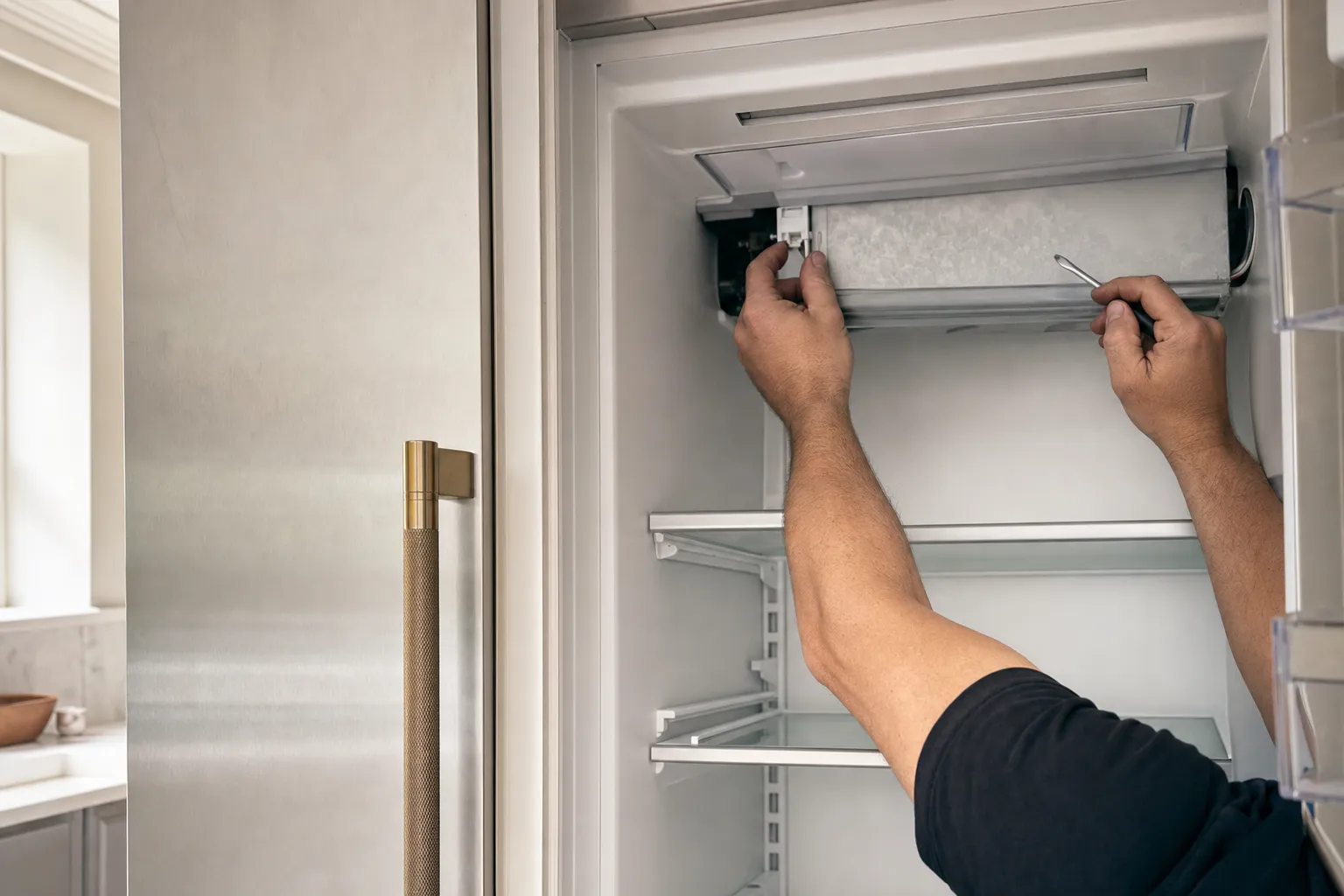
A tall all-freezer keeps its cold in one long, undivided space. Cold air is denser than warm air, so left to itself it sinks and lies in the lower baskets while the warmest air gathers under the ceiling. What prevents that is movement. The cold is made at a coil hidden behind a panel inside the compartment, and a small fan draws air across the coil and sends it back out into the cabinet, around the food and round again. While that loop keeps turning, top and bottom stay close. When it slows, the column sorts itself into layers, and the top shelf is where it shows first.
So a freezer that is soft at the top and hard at the bottom is usually not short of cooling. The machinery may be running normally and the coil may be very cold. The cold is simply not reaching the top of the cabinet.
How the air stops moving
Four things break the loop, and each leaves its own clues.
- The fan has slowed or stopped. A fan motor with worn bearings turns more slowly, then stalls. The compartment warms from the top down while the machinery keeps running, and a faint tick or grind from inside the compartment sometimes comes before it goes quiet.
- The coil is buried in frost. A freezer clears its coil with regular defrosts: a heater warms it, a thermostat or sensor ends the cycle, and the water drains away. If one of those parts fails, frost builds on the coil until air can barely pass through. A white crust on the inner panel is often the visible sign.
- The food is in the way. Sub-Zero notes that overloading affects the temperature inside the unit, and that a freezer needs time to move cold air around unfrozen food. Boxes jammed against the inner panel close off the path the air takes to the upper shelves.
- Room air is getting in near the top. A tall door seals along a long edge. If the gasket has flattened near a top corner, or the door no longer closes fully, warm damp air enters exactly where the column is already warmest.
Telling the fan from the frost
Both faults leave the top warm, so the difference is in the detail. Frost tends to show itself: a white sheet on the panel, frost on the packages nearest it, sometimes the openings the air comes through iced over. A failing fan is often quiet instead: little frost to speak of, but with the door shut there is no sound of moving air. The two can also overlap, because ice building behind the panel can reach the fan blade and stop it. That is why they are diagnosed together rather than one part at a time.
Which band each fix falls in
A replaced fan motor sits in the band set out under evaporator fan motor cost. A failed heater, thermostat or sensor is priced on the defrost system repair cost page, and the coil has to be cleared of ice before a new part can do its job. A tired seal belongs to the gasket band and is priced once the door has been checked for fit.
On a BI-36F all-freezer column the machinery sits behind the grille at the top of the unit. Glance at that grille before you call: lint packed across it makes the whole system work harder and can blur every one of these faults.
Before you call
- 01
Pull out anything packed hard against the inner panel on the top shelf or in the baskets, so air can move past it.
- 02
Look at the inner panel and the ceiling of the compartment for a white crust of frost; a thick sheet there points at the coil behind.
- 03
Close the door on a strip of paper along the top edge and down the handle side; wherever it slides out without drag, room air gets in.
- 04
With the door shut, listen for a fan inside the compartment. A hum from the machinery with no rush of air is worth mentioning.
- 05
Stand a thermometer in a glass of oil on the top shelf and another low down; after 12 hours, note both readings for the call.
Still wrong after that? Sub-Zero Repair Kirkland, (425) 699-2400 — visits eight till eight, every day.
Follow-ups
Why would the top of a freezer be warmer than the bottom?
Cold air is heavier than warm air, so in any tall compartment it pools low unless something keeps it moving. In a frost-free column that job falls to the fan behind the inner panel. When the fan slows or the coil it blows through is packed with frost, the top shelf is left with the warmest air.
Can packing the baskets full cause it?
It can add to it. Sub-Zero's guidance says overloading affects temperatures inside the unit, and that unfrozen food needs time for cold air to circulate around it before more goes in. Boxes wedged against the inner panel also close off the path the air travels, so the shelves beyond them go without.
What should I do with the food in the meantime?
Move the most sensitive food, ice cream and anything you plan to keep for months, down to the bottom baskets, and keep the door shut as much as you can. That buys time but fixes nothing. Sub-Zero Repair Kirkland, (425) 699-2400, can tell from a diagnosis whether the fan or the defrost side is at fault.